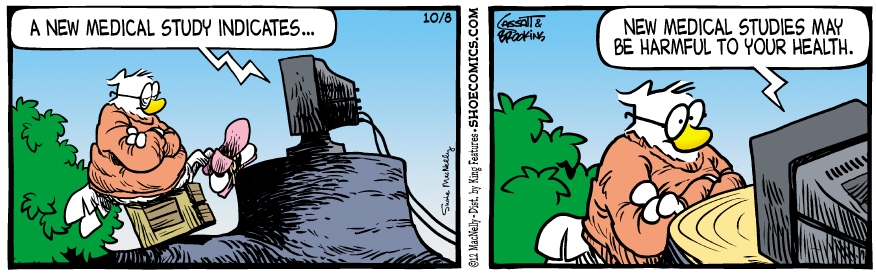
Monday, October 8, 2012

Saturday, October 6, 2012
Jon's Health Report
This is good news for me:
Can you bite into an apple? If so, you are more likely to maintain mental abilities, according to new research.
Aspirin May Slow Brain Decline
An apple a day might keep the cardiologist away
In a study of healthy, middle-aged adults, consumption of one apple a day for four weeks lowered by 40 percent blood levels of a substance linked to hardening of the arteries.
Moderate alcohol intake and cancer: the role of under-reporting
A large US cohort study in 129,987 persons suggests that the apparent increased risk of cancer among light-moderate drinkers is substantially due to underreporting of intake.
Reduced glaucoma risk in patients who take statins
Omega-3 Supplements May Slow A Biological Effect of Aging
Exercise Does a Body – and a Mind – Good
Diet high in total antioxidants associated with lower risk of heart attack
Geneticists verify cholesterol-cancer link
University of Rochester Medical Center scientists discovered new genetic evidence linking cholesterol and cancer, raising the possibility that cholesterol medications could be useful in the future for cancer prevention or to augment existing cancer treatment.
The data, published in the online journal Cell Reports, support several recent population-based studies that suggest individuals who take cholesterol-lowering drugs may have a reduced risk of cancer, and, conversely that individuals with the highest levels of cholesterol seem to have an elevated risk of cancer.
Exercise May Protect Against Future Emotional Stress
A healthy outlook leads to a healthy lifestyle
Literary reading provides "a truly valuable exercise of people's brains."
This isn't good news for me (I've started drinking lots of coffee for the many benefits - and eat too much fish)
Caffeinated Coffee Linked to Vision Loss
Heavy caffeinated coffee consumption is associated with an increased risk of developing exfoliation glaucoma, the leading cause of secondary glaucoma worldwide.
Eating fish may reduce the risk of heart attack, but watch out for mercury
This is no help for me now (but I will try to eat more cherries and watermelon and may go back to eating lots of yogurt - last one - no thanks!):
Milk consumption has been linked to improved health, with decreased risks of diabetes, metabolic syndrome, and colon cancer.
Watermelon Can Improve Heart Health While Controlling Weight Gain
Eating Cherries Lowers Risk Of Gout Attacks By 35%
Yogurt Fights High Blood Pressure
Eunuchs outlive other men
I have no idea if this affects me:
ZINC DEFICIENCY LINKED TO AGING, MULTIPLE DISEASES
About 40 percent of elderly Americans and as many as two billion people around the world have diets that are deficient in this important, but often underappreciated micronutrient, experts say.
I'm OK here:
Gum Disease Bacteria Linked To Pancreatic Cancer Risk
Vitamin D deficiency increases risk of heart disease
Low levels of vitamin D are associated with mortality in older adults
Not going to cut back if I can avoid it:
A moderate dose of exercise induced a markedly greater weight loss, than a higher dose.
Previous (fascinating) reports
September 13
August 10
June 26
June 2
May 18
Friday, October 5, 2012
Chewing ability linked to reduced dementia risk
Can you bite into an apple? If so, you are more likely to maintain mental abilities, according to new research from Karolinska Institutet.
The population is aging, and the older we become the more likely it is that we risk deterioration of our cognitive functions, such as memory, decision-making and problem solving. Research indicates several possible contributors to these changes, with several studies demonstrating an association between not having teeth and loss of cognitive function and a higher risk of dementia.
One reason for this could be that few or no teeth makes chewing difficult, which leads to a reduction in the blood flow to the brain. However, to date there has been no direct investigation into the significance of chewing ability in a national representative sample of elderly people.
Now a team comprised of researchers from the Department of Odontology and the Aging Research Center (ARC) at Karolinska Institutet and from Karlstad University have looked at tooth loss, chewing ability and cognitive function in a random nationwide sample of 557 people aged 77 or older. They found that those who had difficulty chewing hard food such as apples had a significantly higher risk of developing cognitive impairments. This correlation remained even when controlling for sex, age, education and mental health problems, variables that are often reported to impact on cognition. Whether chewing ability was sustained with natural teeth or dentures also had no bearing on the effect.
The results are published in the Journal of the American Geriatrics Society (JAGS). The study was financed with grants from several funds, including the Swedish Council for Working Life and Social Research and the Swedish Research Council.
Aspirin May Slow Brain Decline
Low dose aspirin may ward off cognitive decline in elderly women with a high risk of cardiovascular diseases such as heart disease and stroke, conclude researchers from the University of Gothenburg in Sweden who write about their five-year study in a paper published 3 October in the online journal BMJ Open.
In their introduction, corresponding author Anne Börjesson-Hanson and colleagues explain that many studies have looked at the effect of non-steroidal anti- inflammatory drugs (NSAID) on cognitive decline and dementia, but few have looked at the effect of aspirin on these conditions.
Yet, while researchers have proposed that inflammation might be important in the development of cognitive decline and cardiovascular diseases, and low dose aspirin is widely prescribed to prevent cardiovascular disease, no study has yet examined the effect of aspirin on cognitive function in people at high cardiovascular risk.
For their study, the researchers followed 681 women aged between 70 and 92 for five years. 129 of the women were already taking aspirin at daily doses ranging from 75 and 160 mg, and after undergoing baseline assessments, 601 were classed as having high cardiovascular risk.
Over the study period, the participants underwent more tests of cognitive and thinking skills, including one commonly used in the UK to diagnose dementia, the Mini Mental State Examination (MMSE).
The results showed that while the MMSE scores for the overall group fell over the five years of the study, it fell less for those women taking aspirin.
But although other tests of memory and thinking showed a similar pattern, those results were not statistically significant.
By the end of the study, 41 of the participants developed dementia, but the rate was no different between those on aspirin and those who weren't.
In discussing the possible limitations of their study, the authors say they can't rule out that people with incipient cognitive decline might be less likely to take aspirin anyway.
They conclude that low-dose aspirin treatment "may have a neuroprotective effect in elderly women at high cardiovascular risk".
Simon Ridley, Head of Research at Alzheimer's Research UK, says in a press release:
"The results provide interesting insight into the importance of cardiovascular health on cognition, but we would urge people not to self-medicate with aspirin to try to stave off dementia."
He points out the study found no benefit from aspirin on overall dementia rates, and that previous trials investigating potential benefits of drugs like aspirin for dementia have been negative.
"We know that keeping our heart healthy through regular exercise, a healthy diet, not smoking and keeping our blood pressure and cholesterol in check, can help to reduce the risk of dementia," says Ridley, adding that research into risk factors for cognitive decline must nevertheless become a top priority in the UK because of its increasingly aging population.
Thursday, October 4, 2012
Caffeinated Coffee Linked to Vision Loss
A new study suggests caffeinated coffee drinkers should limit their intake to reduce their chances of developing vision loss or blindness. According to a scientific paper in Investigative Ophthalmology & Visual Science, heavy caffeinated coffee consumption is associated with an increased risk of developing exfoliation glaucoma, the leading cause of secondary glaucoma worldwide.
The study, The Relation between Caffeine and Coffee Consumption and Exfoliation Glaucoma or Glaucoma Suspect: A Prospective Study in Two Cohorts, is the first to examine the link between caffeinated coffee and exfoliation glaucoma in a U.S. -based population.
"Scandinavian populations have the highest frequencies of exfoliation syndrome and glaucoma," said author, Jae Hee Kang, ScD, of Channing Division of Network Medicine at Brigham and Women's Hospital in Boston, Mass. "Because Scandinavian populations also have the highest consumption of caffeinated coffee in the world, and our research group has previously found that greater caffeinated coffee intake was associated with increased risk of primary open-angle glaucoma, we conducted this study to evaluate whether the risk of exfoliation glaucoma or glaucoma suspect may be different by coffee consumption."
The study was composed of two cohorts: 78,977 women from the Nurses' Health Study (NHS) and 41,202 men from the Health Professionals Follow-up Study (HPFS) who were at least 40 years of age, did not have glaucoma and reported undergoing eye examinations from 1980 (for NHS participants) and 1986 (for HPFS participants) to 2008. The research team used questionnaires to obtain and validate the consumption of beverages containing caffeine and reviewed medical records to determine incident cases of exfoliation glaucoma, which contributes to elevated pressure sufficient enough to damage the optic nerve, or exfoliation glaucoma suspect that have milder or only suspect optic nerve damage.
A meta-analysis of the two cohorts showed that, compared to abstainers, participants who drank three cups or more of caffeinated coffee daily were at an increased risk of developing exfoliation glaucoma or glaucoma suspect. The researchers did not find associations with consumption of other caffeinated products, such as soda, tea, chocolate or decaffeinated coffee. The results also showed that women with a family history of glaucoma were at an increased risk.
Kang, along with his colleagues, report that this study represents a much needed effort to better understand the causes of exfoliation glaucoma, which are largely unknown.
"Because this is the first study to evaluate the association between caffeinated coffee and exfoliation glaucoma in a U.S. population, confirmation of these results in other populations would be needed to lend more credence to the possibility that caffeinated coffee might be a modifiable risk factor for glaucoma," said Kang. "It may also lead to research into other dietary or lifestyle factors as risk factors.
Wednesday, October 3, 2012
Watermelon Can Improve Heart Health While Controlling Weight Gain
According to research from Purdue University and University of Kentucky, mice that were given a diet which included watermelon juice received considerable benefits when compared to the control group.
The experts suggest, in the Journal of Nutritional Biochemistry, that citrulline, a compound found in watermelon, was responsible for the mice's lower cholesterol, weight, and arterial plaque.
This study coincides with prior research, also by the University of Kentucky, which found that watermelon consumption caused a reduction in atherosclerosis in animals.
Since other research has demonstrated that consuming this type of fruit can lower blood pressure, explained Shubin Saha, co-author and a Purdue Extension vegetable specialist, they were interested to examine what it could do in this research.
"We didn't see a lowering of blood pressure, but these other changes are promising," Shubin Saha added.
The scientists divided mice into two groups for their investigation, both were given diets high in saturated fat and cholesterol. One group drank water that consisted of 2% watermelon juice, while the other mice drank the exact amount of water mixed with a solution that matched the carbohydrate content of the fruit juice.
Results showed that nearly 50% less LDL cholesterol, or the "bad" cholesterol, was found in the animals who drank the watermelon juice, who also gained 30% less weight than the control group.
A 50% decrease in plaque in the arteries, as well as high citrulline levels, were found in the experimental group.
"We know that watermelon is good for health because it contains citrulline," revealed Sibu Saha, a professor of surgery at the University of Kentucky. "We don't know yet at what molecular level it's working, and that's the next step."
The team hopes to discover a secondary market for watermelons in nutraceuticals, which are food or food components that provide health and medical benefits, such as preventing and treating certain diseases.
Approximately 20% of watermelon crop goes to waste each year, according to Shubin Saha. It may be because buyers think the fruit does not look appealing or because some farmers do not think it is worth spending that much money on harvesting it, as prices drop during the peak of watermelon season.
Shubin Saha explained:
"We could use the wasted melons that can't go to market for extracting beneficial compounds. Growers are putting energy into these crops, so if we can do something to help them market their additional product, that would be a benefit to the industry and consumers."
Low levels of vitamin D are associated with mortality in older adults
Low levels of vitamin D and high levels of parathyroid hormone are associated with increased mortality in African American and Caucasian older adults, according to a new study accepted for publication in The Endocrine Society's Journal of Clinical Endocrinology and Metabolism (JCEM). The study also indicates that the potential impact of remediating low vitamin D levels is greater in African Americans than Caucasians because vitamin D insufficiency is more common in African Americans.
For the past several years, there has been considerable interest in the role vitamin D plays in improving health and preventing disease. Low levels of vitamin D have been directly associated with various forms of cancer and cardiovascular disease. Most studies regarding the health effects of low vitamin D levels have been conducted on persons of European origin, but the current study examines the relationship between vitamin D and mortality in blacks and whites.
"We observed vitamin D insufficiency (defined as blood levels <20 ng/ml), in one third of our study participants. This was associated with nearly a 50 percent increase in the mortality rate in older adults," said Stephen B. Kritchevsky, PhD, Professor of Internal Medicine and Transitional Science at the Wake Forest School of Medicine, and lead researcher of this study. "Our findings suggest that low levels of vitamin D may be a substantial public health concern for our nation's older adults."
In this study, 2,638 Caucasians and African-Americans aged 70-79 years were asked to fast for 12-hours, after which a blood sample was collected to determine levels of vitamin D. Every six months study participants were contacted to ascertain their medical condition. This study determined the proportion of deaths among participants of with different vitamin D levels. In addition to many health factors, the time of year was also taken into account due to the seasonal effects on vitamin D. Researchers found that levels of vitamin D less than 30 ng/ml were associated with significantly increased all-cause mortality.
"We all know that good nutrition is important to overall health and our study adds to a growing body of literature that underscores the importance of vitamin D and indicates that poor vitamin D nutrition is wide-spread," said Kritchevsky. "The good news is it's easy to improve vitamin D status either through increased skin exposure to sunlight or through diet or supplements."
Subscribe to:
Posts (Atom)